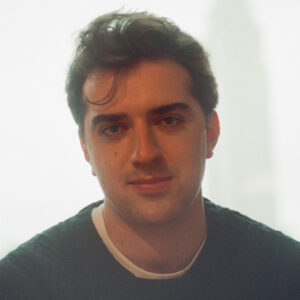
Enjoy this exclusive interview between Script in Hand curator Mark Shanahan and Matthew Libby. Matthew is the playwright of THE MACHINE, our November Script in Hand playreading.
MARK SHANAHAN: The Machine explores the collision of art and technology. What first sparked the idea for this story, and why did you feel theater was the best medium to tell it?
MATTHEW LIBBY: I first started writing this play as my senior thesis in college in 2017, and I wrote it mostly due to circumstance. I’ve always known I wanted to work in the arts, but I explored a general education in undergrad, and ended up being, to my own surprise, a cognitive science major. But I was always on the lookout for ways to get support for my theatre passion; one way I found was an “Honors in the Arts” program, which allowed non-arts majors to get academic honors by completing an arts thesis… but only if the thesis was about their major. I knew I wanted to write a play, and so suddenly I was forced to think about how I would write a play about cognitive science. What was inherently dramatic about what I was studying? One of the things that had always compelled me about looking in totality at every subject that cognitive science entails – computer science, psychology, philosophy, communication, and more – is that it’s all about the question of what’s innately human in an increasingly technological world. What can the algorithm never touch? This struck me as an exciting and universal dramatic idea, one that went beyond the specifics of the tech, and it was the seed that the rest of the play grew from – and I also think is part of the reason why I’m still talking about the play more than 8 years later.
One detail that’s worth mentioning is I had to do a pretty massive rewrite a few years ago after ChatGPT was released. This play used to take place in the present day, and was a piece of speculative fiction. Then, reality caught up with the play and I saw that the only way to save the project would be to place it back in the past, in our last major moment of tech anxiety, to look back in order to look forward.
MARK SHANAHAN: Laney, your protagonist, faces a creative crisis when asked to let a machine imitate her voice. As a playwright, have you ever wrestled with your own version of writer’s block or questions about originality in your work?
MATTHEW LIBBY: All the time. Part of the reason why the play ends the way it does is because I still, even after many years, find the creative process deeply mysterious. So much of my life is trying to chase the feeling of being in creative flow, trying to do everything I can to get there. But sometimes it feels like 95% of my life is NOT writing – other obligations, retooling old material, or just plain procrastination get in the way. I’ve found that the main thing that gets me back on track is, paradoxically, following the instinct to not write if it isn’t feeling good. Instead, I see a ton of plays and movies – going to the theatre or reading scripts always grounds me, allows me to get out of my head, and let myself be inspired. To put it in tech-speak parlance, I need “input” to help create the “output.”
MARK SHANAHAN: Audiences are increasingly fascinated and sometimes unsettled by artificial intelligence. What do you hope people are still talking about on their drive home after experiencing The Machine?
MATTHEW LIBBY: It comes back to the question that animated the play: what’s innately human in an increasingly technological, dehumanizing world? We’re all going to have to fight over the next several years to retain our humanity, to reject any attempt to reduce ourselves to ones and zeroes in the name of efficiency or “progress”. There’s a question raised in the play about what it is we connect with when we connect with art: Is great, say, poetry just the right words in the right order? If it is, then sure, maybe AI can create great poetry. But I feel most people would say great poetry is more than that, and it has to do with something far more ineffable. I hope people leave this play thinking deeper about that ineffable thing – what actually separates us from the machines, and how we as humans can hold onto that.
MARK SHANAHAN: The AI in your play is named Byron, after the poet. How much of Byron’s abilities is rooted in actual existing technology versus pure imagination?
MATTHEW LIBBY: The only thing that doesn’t exist is the idea that there is a way to pump in real-time neural data into the AI – everything else about Byron is based on real existing technology I was studying as an undergrad. Specifically, everything Max describes about how Byron works (the “forger” and the “expert”) is based on a machine learning technique called Generative Adversarial Networks – a cutting-edge concept when I first started writing the play in 2017 and now a massive part of our AI ecosystem.
MARK SHANAHAN: We’re living in a moment when AI is writing everything from essays to pop songs. Did you have any hands-on experience with AI while writing the play?
MATTHEW LIBBY: You know, I’m someone who’s studied and written about AI for over a decade at this point – but I barely ever use it. It’s certainly not a creative tool in my arsenal. I can assure the audience that every word of THE MACHINE was written solely by me!
CLICK HERE or on the graphics above to read Matthew’s full bio.
 English
  Spanish